Iran warns of a prolonged war that could damage the global economy as tensions rise in the Strait of Hormuz. Oil prices surge while the US, Israel, and Gulf states face escalating attacks.
Iran Warns of Prolonged War as Strait of Hormuz Crisis Threatens Global Economy
Iran has warned that it is prepared for a prolonged war of attrition that could severely disrupt the global economy, as tensions continue to escalate in the Middle East. The warning came after Iranian forces targeted two commercial vessels and issued threats against ships linked to the United States or its allies.
The situation has intensified around the Strait of Hormuz, one of the world’s most critical oil shipping routes, raising concerns about the stability of global energy supplies.
Meanwhile, US President Donald Trump suggested that the conflict might end soon, claiming that American forces have already destroyed most strategic targets in Iran.
Oil Markets React as Global Supply Concerns Grow
Global oil prices have climbed sharply since February 28, when the United States and Israel launched a military offensive against Iran that killed Iran’s Supreme Leader Ali Khamenei, triggering widespread conflict across the region.
To stabilize energy markets, the International Energy Agency announced it would release 400 million barrels of oil from member nations’ reserves — the largest coordinated release in the agency’s history.
With the war now entering its second week, the economic consequences are becoming increasingly visible worldwide.
Iran Targets Commercial Ships in Strait of Hormuz
Iran’s Islamic Revolutionary Guard Corps (IRGC) said it attacked two ships — the Liberian-flagged Express Rome and the Thai bulk carrier Mayuree Naree — after they allegedly ignored warnings while passing through the Strait of Hormuz.
The Royal Navy of Oman rescued 20 crew members following the attack, while search operations continued for three missing sailors. Images released by Thai naval authorities showed thick black smoke rising from one of the vessels.
The Strait of Hormuz carries around 20% of the world’s oil and liquefied natural gas, making it one of the most strategically important waterways for global trade.
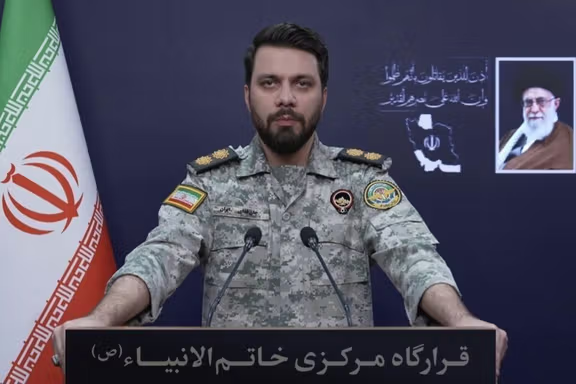
Iranian military officials warned that the United States and Israel must prepare for a prolonged economic and military confrontation.
Attacks Spread Across Gulf Region
Beyond the maritime attacks, the conflict is beginning to impact other Gulf countries.
Drones reportedly fell near Dubai International Airport in the Dubai, injuring four people, according to local authorities.
Several international companies have begun evacuating employees from the city. Financial giant Citigroup and consulting firm Deloitte reportedly asked staff to leave their Dubai offices as a precaution.
Additional drone strikes hit fuel storage tanks at Salalah Port in Oman, forcing a temporary suspension of operations in parts of the port.
Security analysts warn that continued disruptions in the Gulf could have serious consequences for global trade and food production, as the route also carries a large share of the world’s fertilizer exports.
Israel Expands Airstrikes in Iran and Lebanon
Israel has continued military operations in response to Iranian actions. Israeli Defence Minister Israel Katz said the campaign would continue indefinitely until strategic objectives are achieved.
Israeli forces launched what officials described as a large-scale wave of strikes across Iran and against Hezbollah positions in Beirut, the capital of Lebanon.
One airstrike struck an apartment building in central Beirut, marking the second time since the war began that the heart of the city had been targeted.
Residents reported explosions and fireballs erupting from the building. Local authorities confirmed extensive structural damage to the upper floors and nearby vehicles.
Civilians in Iran Adapt to Life Under Airstrikes
Inside Iran, civilians are struggling to adapt to daily life amid ongoing airstrikes.
Some residents say they are attempting to remain calm despite the constant threat of attacks. Markets remain open in several areas, although uncertainty about the future continues to grow.
Iranian authorities have also warned against internal dissent. Police chief Ahmad‑Reza Radan said protesters would be treated as enemies of the state during the conflict.
Leadership Uncertainty After Khamenei’s Death
The death of Supreme Leader Ali Khamenei has created uncertainty within Iran’s leadership.
His son Mojtaba Khamenei has reportedly been named as his successor, though he has not appeared publicly amid reports that he may have been injured during the same strike that killed his father.
Iran’s ambassador to Cyprus said the younger Khamenei was wounded during the attack, though officials have yet to confirm the full extent of his condition.
Rising Casualties in the Conflict
According to Iran’s health ministry, the war has already caused heavy casualties. As of March 8, more than 1,200 people have been killed, while over 10,000 civilians have been injured in US and Israeli airstrikes.
With tensions continuing to escalate across the Middle East, global leaders are increasingly concerned that the conflict could spiral into a wider regional war.